Pages

Sunday, July 28, 2013

Light and Dark


The light shines the way, but the darkness reveals stars.

I have been very fortunate in life. I have everything I could want: a great husband, healthy children, a good career, a home, the opportunities to travel, and the chance to keep on learning to my heart's content.

I'm happy.

But I know that things can change at any moment. They have in the past, and they've taught me invaluable lessons.

You see, those are the gems cloaked in misery--the lessons and tidbits of wisdom you learn about yourself, about others, and about the world.

It's hard to see them in your moment of hardship, but carry on and you'll realize that there are gems shimmering like stars underneath all that misery.

Yes, I've been very fortunate. I'm happy.

But I know that while the light shines the way, it is the darkness that will reveal stars.

Wednesday, July 17, 2013

Climbing Mount Fuji

Have you ever wanted to climb Mount Fuji? I did. In my head, I had this notion that climbing it was going to be awe-inspiring. I knew that it would be tough, but I was going to make it up to the summit and stand tall with a sense of accomplishment, snap awesome photos of the breathtaking sunrise, and then go on my merry way.

Right? Not quite. lol Let me explain.

Mount Fuji is Japan's highest mountain, standing at about 12,390 ft. That's above clouds and fairly high. When I went skydiving last year, I had jumped out of the plane at 10,000 ft, so I knew that if I conquered Fuji, I would be even higher than when I had skydived, and not only that, but I would've climbed up there myself rather than riding on a plane to reach those heights. In short, it was going to be great!

My husband and I were vacationing in Japan and left the Mount Fuji climb for the end of our trip. We had read many articles, blogs, and pamphlets on climbing Fuji, so we felt ready. We set off for the Fuji area on June 30th in order to climb it on the night of July 1st, which is opening day of climbing season.

The recommended way to climb Fuji is to start off in the afternoon around 1 or 2pm and climb until night time. Then pay to sleep and rest in one of the huts along the way and wake up around 2 in the morning to climb the rest of the way to the summit in time for the sunrise. Our plan, however, was to climb Mount Fuji all in one night and make it to the summit by dawn. I dare say, that may not have been the wisest decision, but we were short on time and didn't feel like spending a lot of money to sleep in a hut. So we took a bus to the 5th station around 9pm and set off on the trail at 9:30pm.

We chose to tackle the most often traveled route, which is the Kawaguchi-Yoshida trail. Being that we were climbing at night, it was nice to have other climbers around. It wasn't crowded at all until we got to the top, but having some climbers around meant less darkness and more of a camaraderie experience. This trail (as I'm sure is the same with the others) has stations with little shops along the way where you can buy food, supplies, and use the restroom, albeit for a fee.

How hard was the climb? Well, I consider my husband and I fairly fit. The physical act of climbing itself is not very strenuous. But when you're above clouds, the air is thin with a lack of oxygen. I found breathing to be the most difficult part. Despite going at a slow to moderate pace, we still experienced mountain sickness and were breathing hard with heart thumping away as if we were running a race. Soon we both developed headaches from the altitude and lack of oxygen. Luckily for my husband that was all he had to endure, but for me, I also experienced nausea. We had to buy oxygen in a can when we stopped at one of the stations. As soon as I breathed in the oxygen, I could feel the headache and nausea dissipate, and we were able to push on up the mountain with breaks every now and then to breath in more oxygen from the can.

As for proper clothing and footwear, we were pretty well-prepared. From the readings we had done on Fuji prior to the climb, we knew that there would be a huge temperature difference to deal with. At the 5th station where we started off, it was around 70 degrees Fahrenheit. By the time we reached the summit, it had dropped to 30 degrees. There was snow, wind, and rain up there as well. We dressed in layers. At the bottom, I wore just my workout tights and a t-shirt. As we ascended and temperatures dropped, I layered on more clothes, so that by the time I got to the top, I was wearing 3 shirts, a rain-proof jacket, 3 pants, hat, gloves, and hand and foot warmers.

I saw lots of people wearing tennis shoes and that works too, but we rented hiking boots, which was great for ankle support for the climb down. It was about a 45 degree slope the whole way down on loose lava gravel and bigger rocks. Easy to turn an ankle. The bad thing about the rental boots was that they weren't broken into very well yet. I got huge, deep blisters on the back of my foot. I had to deal with that for much of the entire climb. I took a picture of my bursted, raw blisters and posted it on Facebook. It grossed out a lot of people, so I won't share the photo on here.

We also each wore a head lamp, which I would highly suggest. There are many steep parts, and you need your hands free to grab onto rocks and hoist yourself up. Plus, when you're so tired and worn out, the last thing you want is to have to hold a flashlight in your hands. Additionally, we each carried a backpack with water, food, and clothes.

To reach the top, it took us 8 hours. We got there, saw the orange streaks of light beginning to appear, positioned ourselves and our cameras, and snapped some photos of the sunrise. We rested up there for about 30 minutes. Since it was very early in the climbing season, many of the shops at the summit were still closed. There's a post office up there too for sending post cards out with the special Mount Fuji postmark, but that was still closed as well. I went in search of a toilet but found none to be open, so we began our descent down the mountain.

To reach the bottom was another 4 hours on a different path. Let me tell you that this was probably worse than the climb up. Why? Because it was the same monotonous slip and slide motion the whole way down. It was also daytime, and at a high altitude, the sun beats down on you more intensely.

Another thing... remember when I said I couldn't find a toilet up on the summit? Yes, well, on the way down, there were also absolutely no restrooms whatsoever for hours. I'm not kidding when I say my bladder was about to explode. After 2 hours, I was finally at my wits' end. As we were on a dry, barren, and steep mountain top with nothing around but lava gravel, there was literally nowhere for me to go hide behind to do my business either. So finally I had my husband block me with our backpacks and his body, and I just squatted right there on the path and peed. I've never in my life done something like that before, and I hope to never do it again. lol But hey, sometimes you just gotta do what you gotta do.

Perhaps another reason why going down seemed so much worse was because we had been physically climbing the mountain for what seemed like forever. We were operating on very little sleep and were exhausted, dirty, hungry, and sweaty. It is not a far stretch to say that we were beginning to hate the world and everybody in it, including ourselves. Many times, I questioned myself, "Why the hell am I doing this?!" At other times, I would kick a rock and hate it for being there to trip me up and make me slip. How dare that rock! lol

All in all, the total time it took to conquer Mount Fuji: 12 hours straight. That's the most difficult and longest stretch of physical activity I've ever done.

If you were to ask me about my Fuji experience then or even a week afterwards, I would've described it as akin to torture, and that I would never wish it on my worst enemy. lol  Ask me now and I'm much more appreciative of it.

So was it worth it? I guess I'll give it a resounding yes. Below are photos. :)

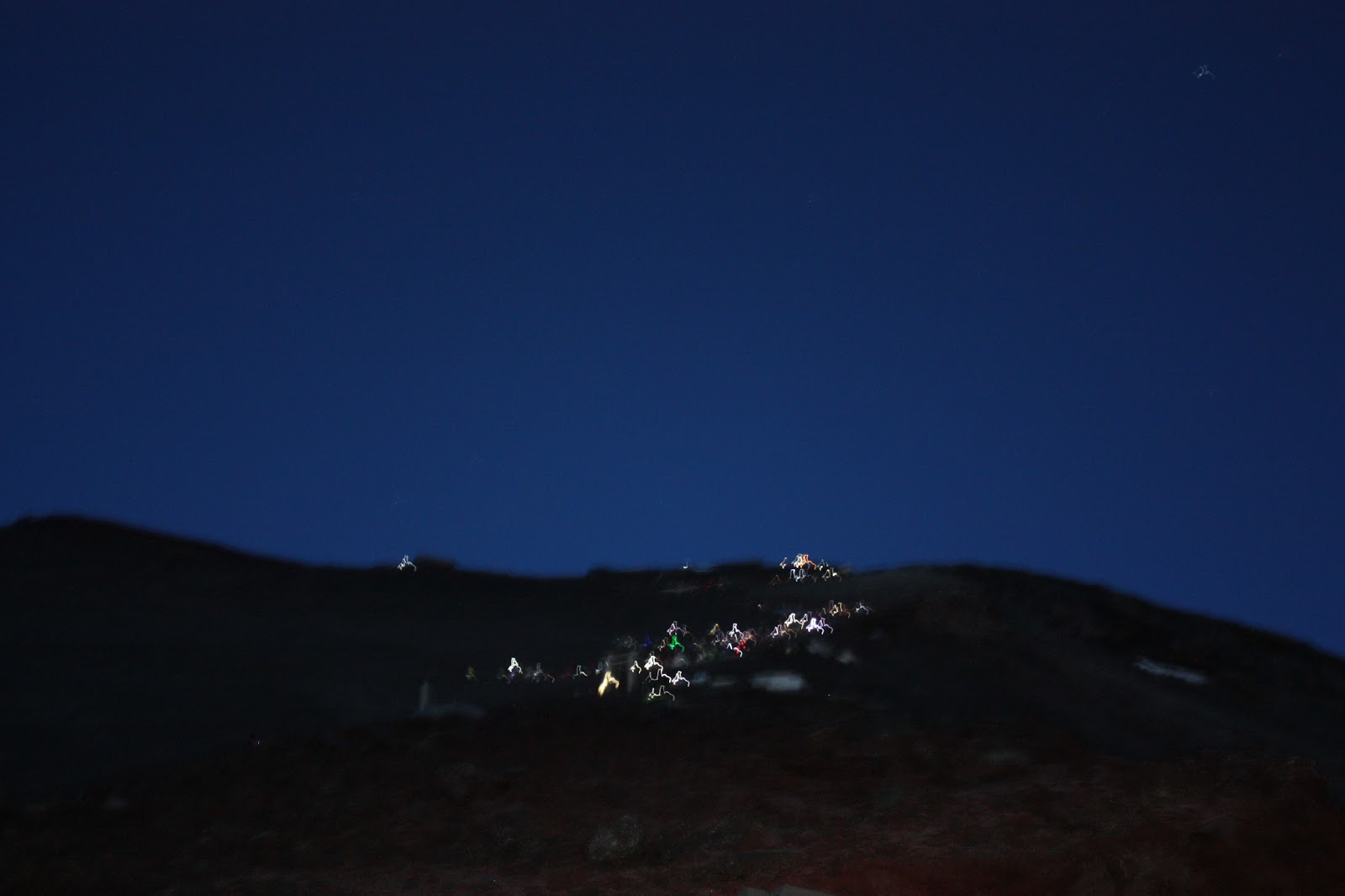
The line of climbers in the dark of night, each making their way up Mt Fuji.
The first indication of the dawn breaking: an orange glow stretching far and wide across the horizon.
Dawn on Mt Fuji
My husband gazing at the sunrise.

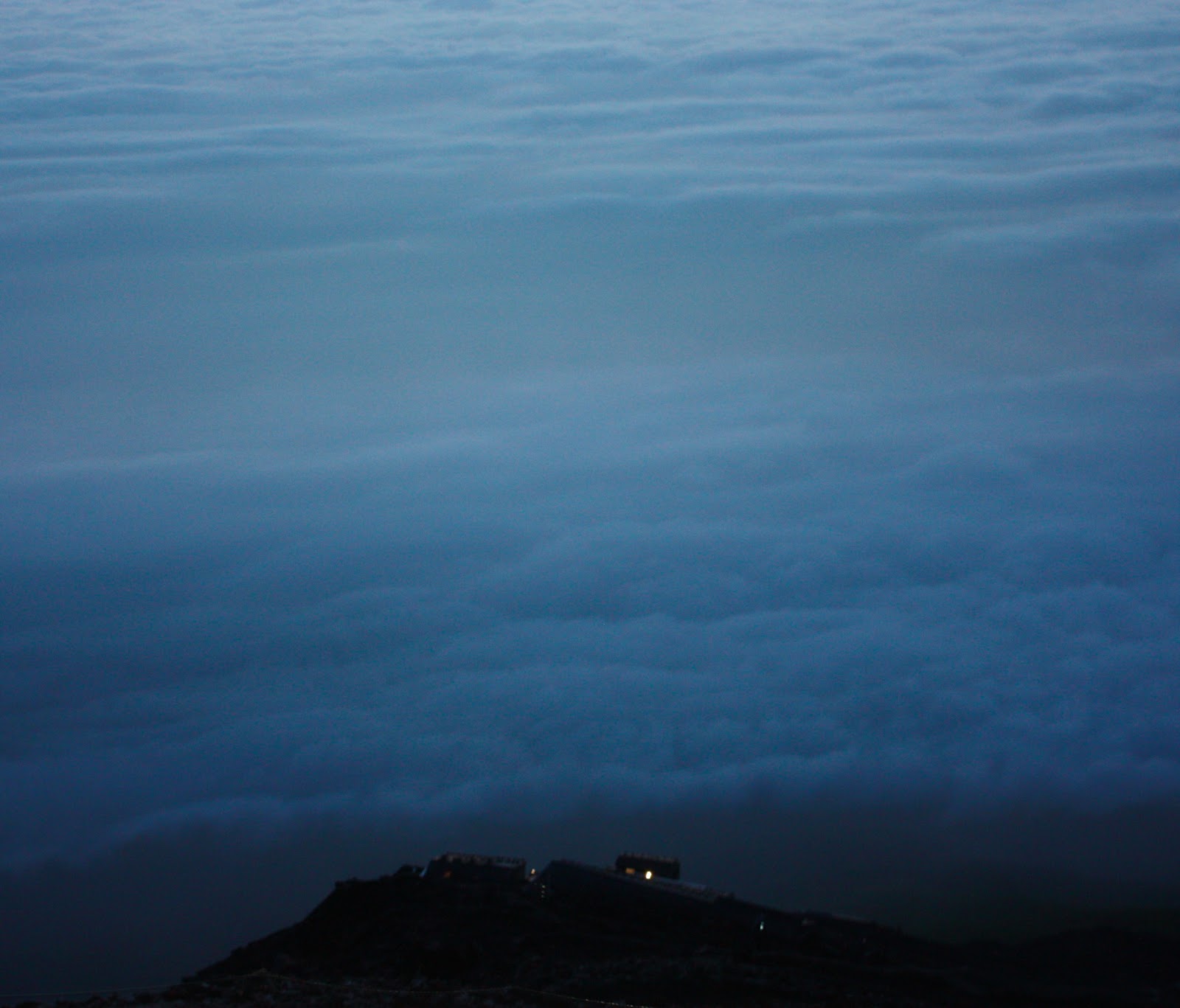
Lone huts amidst a sea of clouds on Mt Fuji.
This photo gives an idea of the terrain on the way down the mountain: loose lava rocks.
After 2 hours of descent, we were finally almost level with the clouds. We also began to see vegetation. Signs of life! I was so happy.
On the way down, there was really nowhere to rest, no shops, benches, restrooms, or anything for the longest time. People just rested anywhere they could find a spot that wasn't too slanted. Here we are resting on the side of the path like homeless people.
Although the sunrise was a beautiful sight, I found the sweeping expanse of clouds below to be more captivating. Just the idea that I was walking around higher than clouds...it's pretty amazing.

So yes, I can now say that I've climbed Mount Fuji, but will I ever do it again? Heck no! lol But that is now another item I can cross off my bucket list. :)


Friday, June 14, 2013

Scenes from My Joggings

Back in January, I made a goal of becoming more fit. One thing about me is that if I set my sight on something, I have to fulfill it. Usually I succeed; sometimes I don't. For this particular goal of getting fit, I started off by working out once a week--going to the gym and lifting weights, which was something I used to do adamantly at least 5 days a week but had not done so in more than a couple years.

Gradually I began adding in some running. I have never been much of a runner. I think my form is bad, and it just feels painful to me. However, I've been working on my breathing and trying to improve my form, and I'm happy to say that in the last half year, I've made some good improvements in running. I'm now able to do 3 miles in about 27 minutes.

My husband and I have also incorporated working out into our family routine. We jog or work out with our 3 kids Mondays, Wednesdays, and Fridays. On the days that we jog, we usually like to drive out to some trails and go for about 2 miles. It's created some great family moments for us.

Below are some photos of scenes from our various jogs. This is one of the best parts of jogging outdoors: the beautiful scenery and parts of nature that you otherwise may never have seen.


Tuesday, May 14, 2013

Gene Testing for Cancer

The first bit of news I wake up to today is about Angelina Jolie's preventive double mastectomy.... wow....

Well, good for her. I'm glad she's taking a proactive approach and I'm sure her coming forward with this news will prompt other people to get their genes tested for cancer too.

So far my family has only ever suffered from smaller health issues, such as migraines and urinary infections, but my husband's side has had quite a few people pass away from cancer: his father from stomach cancer, his aunt from thyroid cancer, and a cousin from leukemia. Those are just the people in his family that we know of who were officially diagnosed with cancer, as of course there is no knowing what illnesses our Hmong ancestors suffered from while living in remote, agricultural Laos. They didn't have doctors, clinics, tests, etc. Our family's medical history beyond our time in the United States, beyond our parents' generation, is pretty much non-existent.

One of my biggest fears in life is that my husband or my kids will be hit with cancer. I worry about it probably more than I need to, but it's hard not to think about it.

Does gene testing cover other types of cancer also? Something to look into...


Sunday, May 12, 2013

Mother's Day

"All that I am, 
or hope to be, 
I owe to my angel mother."
~ Abraham Lincoln ~


I'm blessed to have a mom who taught me the strength of what it is to be a mother, and I'm blessed to have the opportunity to be a mom to my three wonderful girls.

Happy Mother's Day to all mothers and mothers to be!


Sunday, April 14, 2013

Daughter of Refugees: My Childhood School Years

Awhile back, my youngest daughter's school had Grandparent's Day, a special day for grandparents to visit the classroom. My daughter invited her grandma on my side of the family.

On the day of the event, my mom arrived and I explained to her what the event was and in general what they would probably be doing at school. Then I dropped my mom and my daughter off.

After school was over later that day, my mom and I were talking about how the event went when she asked me in Hmong, "Did you ever have events like this at school when you were a kid? Days for parents and grandparents to come...?"

I told her that I did. There were Parent's Day, Grandparent's Day, concerts, and many other school events.

Then my mom asked, "How come your dad and I never went to any of these things when you and your brothers and sisters were kids?"

I could tell that she was working through something in her head.

"Mom," I said. "It's okay. You and dad didn't know about these things when we were young. There were letters and invitations sent home by our teachers, but you didn't know. I mean, how could you know?"

There was a short pause. Then my mom said, "There were some kids today at school whose grandparents didn't come. Nobody was there to celebrate the special day with them. They were sad..."

Then she looked away, and I knew that it had clicked with her:
What school must've been like for my siblings and me... for us, the children of refugees and of parents who had never been educated and knew nothing of the educational system or of the experience of going to school... the homework, projects, and studying for tests that we did entirely on our own at home, whether right or wrong, because our parents didn't understand the subjects and couldn't help... the things we must've felt and gone through at school that she had never been aware of before.

The letters and invitations sent home by our teachers either ended up in the trash unread, or if they were read, they were not understood. My parents didn't know English, and back in those days, especially in our little town, there were hardly any Hmong translators or Hmong ESL aides to assist in bridging the Hmong home life with the American school system.

And to be frank, we were very poor and sometimes my parents were just too busy trying to support our family and needing to put food on the table, keeping us clothed, and paying for rent. Those were often first priorities over what seemed like trivial school events.

My mom was quiet for a long time, sitting on my beige couch, looking out the window.

Finally, I said to her, "You supported us in your own way, mom."

And I meant it. I really did. For refugees who knew nothing about America upon arrival, my parents have gotten us to progress farther in life than we could've ever done on our own. That I'm certain of.

But yet as I sat there watching my mom's reaction to Grandparent's Day, tears formed in my eyes. They were both sad and happy tears.

Tears for my mom, who could not have known about all those school events... for the lonely school child still in me.. and for my own kids' lives free of these kinds of issues.

Thursday, March 28, 2013

The Meaning Behind My Tattoos

To me, tattoos are personal and meaningful artwork bestowed upon the body. I have two tattoos, and both have significant meaning to me.

The first one represents my family. My name in Hmong is Nou (or "Hnub" as spelled in my native language--pronounced "new"), and it means sun. Hence the image of the rising or setting sun. The bonsai is my husband's favorite tree, and the three little birds are for my three children. Hence the silhouetted bonsai and birds.


The idea for this tattoo came about as a result of a blue birthmark on my right shoulder, which I wanted to hide... not that it bothered me a great deal but people who saw my birthmark were always assuming my husband was beating me up. Poor guy was constantly getting dirty looks from strangers as it looks exactly like a bruise. lol  So I decided to get a tattoo that would cover up the birthmark. If you look closely at the sun, you'll see that there are some bluish or darker hues to it (in the middle, closer to the orange/red parts). That is the birthmark underneath. I also love this tattoo because I love landscape photos, especially those with the sun in it. This tattoo reminds me of beautiful landscapes, the kind that makes my stress and tensions melt.

My second tattoo stands for my ethnicity and culture. It is representative of the traditional Hmong necklace, which is called a "xauv" (pronounced "sah-ow")


There is a sun on the pendant part, again for my name, and the necklace part consists of two tulips, which are my favorite flowers. When I see my tulips pop out of the ground every spring, it's always an ecstatic moment for me. Simple things like that can make me so happy. I suppose it's just symbolic of all that is spring--new beginnings, warmth, and the most positive of outlooks... which brings me back full circle to my culture.

I'm a fairly Americanized person. I grew up in a very white town and hung out with white people rather than Hmongs. There was a time when I really had no care for my culture at all; I was what some would call "white-washed" or a "twinkie." However, as I've grown older, I feel myself being pulled back to the Hmong culture and wanting to embrace it more. So in a way, this represents new beginnings for me, a return to the culture, land, language, and traditions held so dear by my parents and elders.

Originally, this tattoo was going to be placed around my ankle, but it turned out the image would've had to be made much smaller, so I decided to put it on my side instead.

Both tattoos were designed specifically for me. I don't think I could ever walk into a tattoo parlor or look for images online and just pick out an already made design. It just doesn't feel as meaningful. If it's going to be on my body permanently, then I want it customized, and frankly, I want to be the only one with that tattoo walking around. A distinctive artwork. That's how I see it.

Do you have any tattoos or want any? And if so, what do you have, or what would you want?

Wednesday, March 13, 2013

Hope Revisited

When I was a child, I thought I could be anything I wanted. Anything at all.

It's what we're taught in school, right? It's what many parents tell their children. It's what I find myself repeating to my kids sometimes when we sit down and talk about their future. I want them to know that with hard work and determination, yes, it's true... they can become anything they want.

Right???

Now we can discuss the merits of whether that kind of mentality is truly accurate or whether it's just a facade. And we can dip into political and social issues and go into what keeps certain bodies of the human race down while others rise so unseemly...we can name injustices as to why this happens. We could, reader.

But that's not really what this post is about.

You see, lately I've been feeling like something is lost. As we age, something gets destroyed, and the more I think about it, the more I'm convinced that it is hope that's lost.

Now I've written about hope before, way back when I first started this blog a few years ago. And I'm revisiting it again, because out of all of the human emotions, I believe that hope is the most powerful and potentially the most life-changing... if we let it be.

When you have hope, it literally lights up your world. But when hope falters, there is nothing worse than the darkness that seeps in and settles.

Think back to your childhood. In the eyes of a child, all is possible; nothing is uncertain.

As we age, the possibilities chip away little by little; the uncertainty rises.

Now I like to think I'm a hard worker, a go-getter. If there's something I want, I go for it and I don't like excuses. I take my time in whatever I do; after all, I want to do it well, not just rush through for the sake of having done it.

But I'm not going to lie. There is always a little voice inside my head that questions my actions and the possibilities I'm reaching out for. Why are you doing this? It says. What makes you think you can accomplish that? Sometimes it simply says, you're tired. Just rest. Who cares.

And sometimes I listen to it. Sometimes I don't. Regardless, I've noticed that I've increasingly let go of hope and the possibilities of what I could do with my life.

This is not to say that I no longer have hope, but it's that childhood sense of hope that I miss. You know the one I'm talking about. The one in which a mere stick is transformed into a sword to slay monsters with and rid the world of evil. The one in which the future stands bold like an exclamation mark instead of the question mark that we too often see as adults.

Somewhere through the years of life, we've learned the word "can't" and we've internalized it so well that it's just a natural part of who we are.

Of course I'm not silly enough to believe that a mere stick can really solve the problems that exist, like it once did when I was a child. But perhaps it's time to pretend a little and just believe that all things are possible. Just have a little more hope. That is all.

For life seemed better then, when we were kids and when all things were possible. Didn't it?

Hmm, perhaps I'm just feeling a little gloomy today. Tomorrow when I wake up, maybe the world will be as promising as it ever was...